

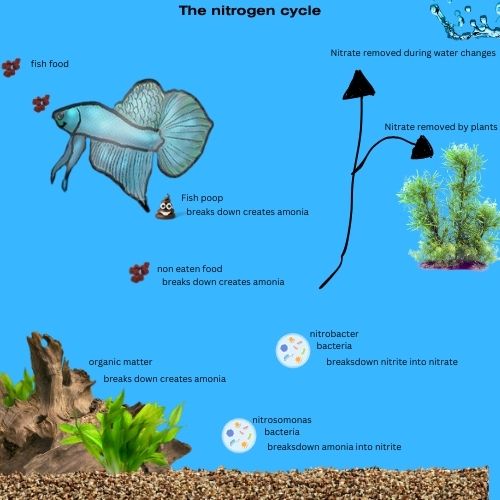
Cycling an aquarium is a crucial process that establishes beneficial bacteria colonies in the tank to break down harmful ammonia and nitrite produced by fish waste. This process is called the nitrogen cycle and is essential for creating a healthy and stable environment for your aquatic pets. Here’s a step-by-step guide on how to cycle an aquarium:
As an Amazon Associate, I earn from qualifying purchases.
- Set up the aquarium:
- Rinse the tank, gravel, decorations, and any other items that will be placed in the aquarium. Rinse them thoroughly to remove any dust or debris.
- Install the filtration system and any other equipment, such as heaters and air pumps.
- Add water:
- Fill the aquarium with conditioned water. Use a water conditioner to remove chlorine, chloramine, and other harmful substances from tap water. For example, some commonly used ones are Seachem prime and Tetra AquaSafe for bettas.


- Add beneficial bacteria:
- There are several ways to introduce beneficial bacteria to kickstart the cycling process. You can use:
- Cycling starter products: These contain live beneficial bacteria that can be added directly to the aquarium according to the product instructions. For example, some commonly used ones are Seachem stability, and Tetra Safestart plus
- There are several ways to introduce beneficial bacteria to kickstart the cycling process. You can use:


- Established filter media: If you have access to filter media from an established, healthy aquarium, you can place it in your new tank’s filter. The bacteria on the media will help seed the new tank.
- Substrate from an established tank: Similarly, you can use some gravel or substrate from a cycled aquarium to introduce beneficial bacteria.
- Add Ammonia source:


- To feed the beneficial bacteria and promote their growth, you need a source of ammonia. In a fishless cycle, you can add liquid ammonia (without additives like perfumes) to the tank. Follow the instructions on the ammonia product to add a small, safe amount of ammonia to the water. An easy one to use is DrTim’s Aquatics Ammonium Chloride Solution for Fishless Cycling.
- Test the water:
- Use a reliable aquarium test kit to monitor the water parameters regularly. You should test for ammonia, nitrite, nitrate, and pH levels.
- During the cycling process, you’ll observe ammonia levels spiking first, followed by nitrite levels rising and then eventually dropping as nitrate levels increase.
- Clean water is crucial for the fish’s recovery. Regularly test the water parameters (ammonia, nitrite, nitrate, and pH) to ensure good water quality. Perform partial water changes (20-25% of the tank volume) every 1-2 weeks or according to the water test this will keep the water clean and healthy. Use a reliable and accurate test kit, for example API freshwater master test kit.


- Wait and monitor:
- The cycling process can take anywhere from a few weeks to a month or more to complete. Patience is crucial during this period. Avoid adding any fish until the cycle is complete, as high levels of ammonia and nitrite can be harmful to them.
- Partial water changes:
- As the ammonia and nitrite levels rise, you may need to perform partial water changes. Sometimes the PH may drop too low and affect the growth of the beneficial bacteria, in this case a water change may be needed, or the cycle may take much longer. When changing water, try not to disrupt the bacterial colonies during this process. Some people do not change for the entire cycle.
- Cycle completion:
- The cycle is complete when you observe a significant drop in ammonia and nitrite levels, and nitrate levels are detectable. At this point, the bacteria have established a healthy balance to process the waste produced by fish. If there is zero ammonia and zero nitrites, and only some nitrates the cycle is complete.
- Gradual introduction of fish:
- After the cycle is complete, you can slowly introduce fish to the aquarium. Lightly feed and monitor the water parameters to ensure the system can handle the bioload.
Remember, cycling an aquarium is vital for the well-being of your fish, so resist the temptation to rush the process. A properly cycled tank will lead to healthier, happier Betta and aquatic life in the long run.
 Betta Universe
Leave a comment